

Who We Are
What We Do
First Minutes Matter

LifeFlight’s PMAWHS214 Undertake helicopter safety and escape course focuses on equipping participants with the knowledge and skills required to exit a helicopter under abnormal aquatic conditions. You may otherwise know of this course as HUET.
LifeFlight Training Academy | RTO 2762
PMAWHS214 Undertake helicopter safety and escape covers the essential safety procedures and survival techniques required to escape from a submerged or inverted aircraft (helicopter or small fixed wing) and includes sea survival training. This comprehensive training is specifically designed to heighten safety procedures, danger awareness and operational standards for flights over or near water.
The course combines theoretical knowledge with invaluable hands-on practical training using LifeFlight’s underwater escape training simulator.
Successful completion of this course will result in the issue of a Statement of Attainment in PMAWHS214 Undertake helicopter safety and escape.
This course covers:
This course is necessary training for aircrew, marine pilots, fire industry, government personnel, media representatives, tourism operators, aviation medical professionals and any person whose job role requires them to fly over water in either a rotary wing or fixed wing aircraft.
The PMAWHS214 Undertake helicopter safety and escape course includes both a practical and a theoretical assessment.
The practical component is assessed through observation of your performance whilst making an escape from the underwater escape training simulator in a variety of situations including upright, inverted and black-out conditions.
The theoretical component is assessed via a written exam at the end of the course.
Once you’ve been deemed competent in your overall performance, you’ll receive a nationally recognised Statement of Attainment in PMAWHS214 Undertake helicopter safety and escape.
Before commencing the course, students must complete enrolment forms and waivers. Additionally, a Unique Student Identifier (USI) must be provided. Details can be found under Unique Student Identifier below.
For Recognition of Prior Learning (RPL), assessments must be submitted for marking before the course date.
Please inform us if you are unable to swim, have a fear of water, or confined spaces, as this information helps us ensure your well-being during training.
Course content may be tailored to suit specific company or organisational operations. Discuss your needs with us during enquiry.
HUET courses are conducted over one day and the normal duration is approximately eight hours.
EBS courses are conducted over half a day and the average duration is approximately four hours.
For all other courses, please contact us directly as the duration may vary depending on location, units selected and number of participants involved.
Knowledge of theoretical components of training will be assessed through the use of written questionnaires. Practical competency will be conducted through observing skills. Both assessments will be conducted at the end of each component of training. Notification of results will be given at the completion of the days training.
All assessment and practical resources are provided by the LifeFlight Training Academy.
You will be notified upon course confirmation if you’re required to bring any wet gear for pool training.
A Unique Student Identifier (USI) is required by all Australians undertaking nationally recognised training. It allows students to link to a secure online record of all qualifications gained regardless of the provider. This system was implemented by the Australian Government in 2015, so it will show student achievements from 1 January 2015 onwards. As an RTO, The LifeFlight Training Academy cannot issue Statements of Attainment without a USI. Therefore, it is mandatory that all students supply their USI upon enrolment.
If a student does not have a USI, they can visit https://www.usi.gov.au/students/get-a-usi for more information, and instructions on how to apply.
Invoices are currently organised once enrolments have been received and your placement is confirmed on a course.
Once invoiced, you have the option to pay via credit card or bank transfer.
Please note, credit card payments over $1500 will incur a 1.15% surcharge fee (employer).
Individual students are not charged more than $1500 in advance or at any stage during the course.
No, unfortunately we are not an OPITO accredited facility. We do offer Nationally Recognised Training Qualifications for EBS & HUET competencies, but we don’t have OPITO accreditation which is required of most employees working in the offshore industry.
Yes. Participants must:
An LLND assessment may be conducted as part of the enrolment process to ensure each participant has the appropriate level of skills required to undertake this course.
A Unique Student Identifier (USI) is a unique education number made up of a combination of 10 letters and numbers. You only need to create it once and it stays with you for life.
It is required for any nationally recognised training course and it also provides you with access to an authenticated record of all of your vocational education and training achievements since 2015.
You can create or find your USI here.
Yes. You will be required to egress our underwater escape trainer completely unaided. You will also be required to swim approximately 20 metres completely unaided.
We can cater to any fear of water or confined spaces you may have – please speak with a member of our training team for a confidential chat so that we can best support you during the practical component of the course.
Yes. Whilst the course outcomes must still adhere to the requirements contained within the unit of competency, we can tailor the course to suit your organisation’s SOPs or specific PPE.
Yes. If you have a minimum of 6 people, we can take a group booking that ensures there will be no other participants in your course. Please be aware that the course entry requirements apply to each member of your group. If you wish to make a group booking, please contact a member of our team.
LifeFlight Training Academy is not an OPITO-approved training provider. The advertised EBS/HUET units are nationally recognised Australian VET products.
Yes. Both the Civil Aviation Safety Authority (CASA) and the Australian Maritime Safety Authority (AMSA) advocate regular HUET training to improve survivability in the event of an aircraft ditching.
LifeFlight recommends undertaking refresher training every two years.
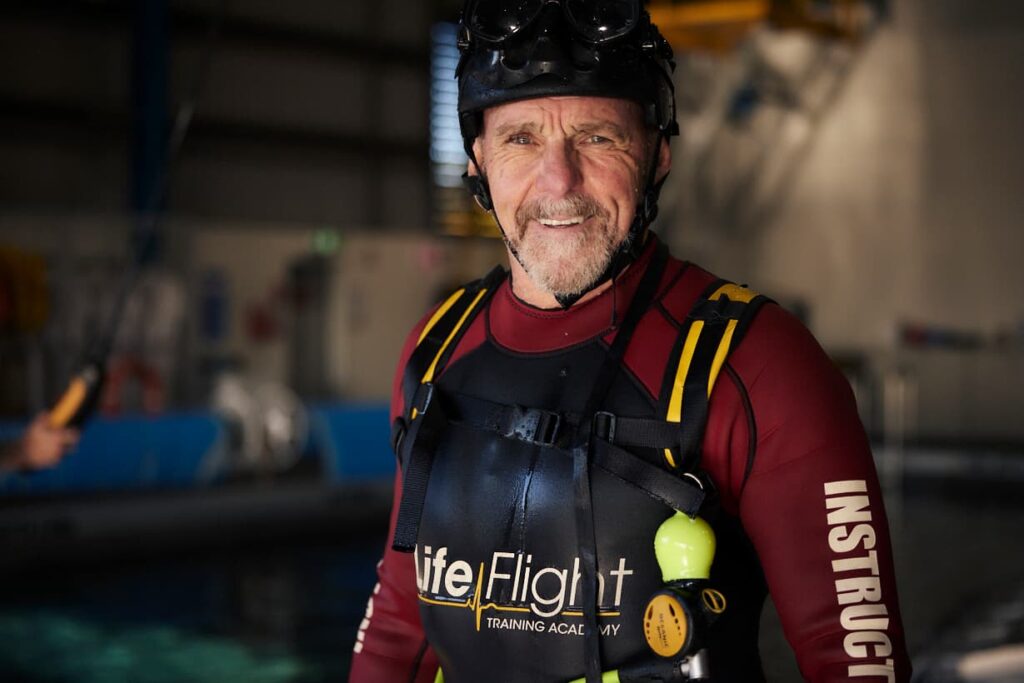
Take the first step towards enhancing your aircraft underwater safety and escape skills with LifeFlight’s HUET.
| Name | Course Start Date | Course End Date | Cost | |
| 21 Oct 2026 - HUET Initial (Brisbane) | 21/10/2026 | 21/10/2026 | $1,100.00 | |
| 25 Nov 2026 - HUET Initial (Brisbane) | 25/11/2026 | 25/11/2026 | $1,100.00 | |
| 10 Dec 2026 - HUET Initial (Brisbane) | 10/12/2026 | 10/12/2026 | $1,100.00 | |
| 11 Feb 2027 - HUET Initial - Brisbane | 11/02/2027 | 11/02/2027 | $1,100.00 | |
| 10 Mar 2027 - HUET Initial - Brisbane | 10/03/2027 | 10/03/2027 | $1,770.00 |




Candidates undertaking the practical component of the course will need to bring the following items with them on the day: